Introduction
Vehicle inspection is a mandatory periodic check imposed by Moroccan regulations to verify a vehicle's mechanical condition and safety. This inspection, regulated by NARSA (National Road Safety Agency), aims to reduce the number of accidents related to technical failures and protect all road users.
Driving with an out-of-date vehicle inspection exposes the driver to sanctions, vehicle immobilization during traffic checks and complicates key administrative procedures such as registration transfer, car insurance subscription or vehicle sale.
This practical guide explains step-by-step what vehicle inspection is, when it must be done, what documents to prepare, how the test proceeds, what points are checked, how to interpret results and how to prepare effectively to pass on the first attempt.
Legal information: This article is provided for informational purposes. Rules, frequencies and fees may change. For up-to-date official information, consult NARSA (narsa.ma) or contact an approved center. When in doubt, seek professional advice.
What is vehicle inspection in Morocco?
Definition and regulatory framework
Vehicle inspection is a mandatory periodic inspection performed at a state-approved center. Its objective: ensure the vehicle meets safety, environmental and operational standards defined by Moroccan regulations.
The supervising authority is NARSA, which approves inspection centers, defines inspection protocols and publishes the list of points to check. Inspections are performed by approved agents, trained and certified to official standards.
What is inspection for?
- Road safety: detect defects that could cause accidents (brakes, steering, lighting)
- Environmental protection: verify pollutant emissions remain within tolerated limits
- Administrative validity: the inspection sticker is required for many procedures (transfer, insurance, import)
- Vehicle value: a vehicle with up-to-date inspection resells better
When must you pass vehicle inspection?
Frequency depends on several factors: vehicle age, vehicle type (passenger car, utility, taxi) and use. Precise rules are defined by current regulations.
Check with NARSA: the frequency applicable to your vehicle may differ by category. Consult narsa.ma or the nearest approved center to confirm your next test date.
General principles
- Recent vehicles generally benefit from a deferred first test
- Beyond a certain age, frequency increases (more frequent tests)
- Professional-use vehicles (taxi, transport) follow a specific regime with increased frequency
- A change of ownership may require a recent vehicle inspection to validate the transfer
What happens in case of delay?
Driving with expired vehicle inspection exposes the driver to:
- A fine provided by regulations
- Possible vehicle immobilization
- Insurance refusal or coverage suspension in case of claim
- Inability to perform certain administrative procedures
Documents and preparation before the test
What to bring
For an efficient test, prepare these documents in advance:
- Valid registration certificate (carte grise)
- Owner's or driver's ID document
- Previous vehicle inspection report if it exists
- Up-to-date insurance certificate (depending on center)
- Test fees (rate is displayed at each approved center)
Vehicle preparation
Minimal preparation greatly increases first-time pass chances:
- Correct tire pressure and satisfactory general condition
- Working lights (dipped, main, indicators, stop, reverse, plate)
- Functional wipers and washer
- Operational parking brake
- Oil level, coolant, brake fluid checked
- Windshield without major impact in field of vision
- License plate readable and compliant
Step-by-step test procedure
Step 1 — Reception and administrative check
On arrival, the agent verifies agreement between registration and vehicle (chassis number, license plate), records your file and collects test fees.
Step 2 — Exterior visual inspection
The agent checks general body condition, windows, lights, plates and visible safety elements (mirrors, bumpers, structure).
Step 3 — Safety component inspection
On ramp and ground, the agent notably checks:
- Braking system (efficiency, balance, parking brake)
- Steering (play, alignment, operation)
- Suspension and shock absorbers
- Tires (wear, compliance, sidewall condition)
- Lighting and signaling
Step 4 — Emissions check
Measurement of pollutant emissions according to engine type (petrol or diesel). The vehicle must meet thresholds defined by Moroccan regulations.
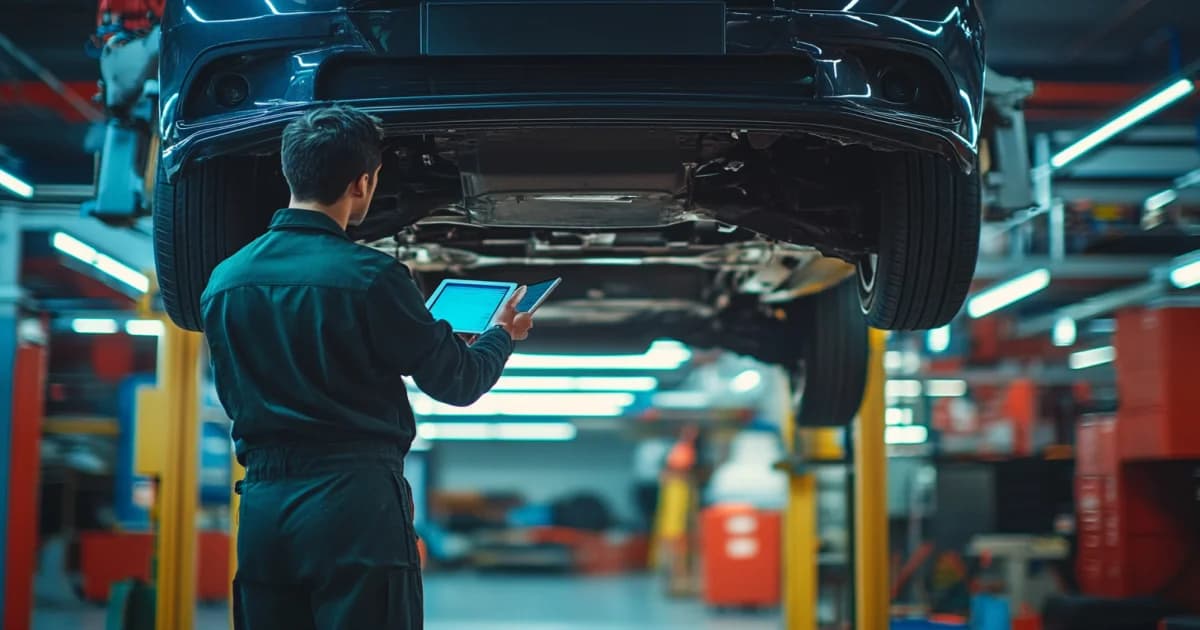
Step 5 — Undercarriage inspection
Verification of transmission, accessible mechanical components, exhaust, chassis and absence of leaks.
Step 6 — Report delivery
At test end, the agent delivers a vehicle inspection report specifying the result: favorable, unfavorable or requiring retest.
Understanding possible results
Favorable result
The vehicle is compliant: an adhesive sticker is affixed to the windshield and the report mentions the validity date. You can drive normally until the next deadline.
Result requiring retest
Certain identified defects must be repaired within a set period, then the vehicle must be presented again for targeted verification. Defects are classified by severity; critical defects require mandatory retest.
Unfavorable result
If the vehicle has major failures seriously affecting safety, its circulation may be restricted until compliance is restored.
Costs and fees
Vehicle inspection fees vary by vehicle type (passenger car, utility, engine type) and are displayed mandatorily at each approved center. Retest fees are generally reduced compared to the initial test.
Official source: for current fees, consult the fee schedule published by NARSA on narsa.ma or directly at the approved center. Avoid any intermediary offering amounts outside official pricing.
Approved centers: how to choose
Reliability criteria
- NARSA approval prominently displayed at the center
- Certified staff and standard-compliant equipment
- Transparency on fees and procedure
- Reviews from other users and geographic proximity
Official list
The up-to-date list of approved centers is published by NARSA on narsa.ma. It's the only reliable reference; beware of intermediaries presenting themselves as "official centers" without being listed.
Common mistakes to avoid
- Postponing the test until the last minute (centers saturated at month end)
- Neglecting tire pressure and fluid levels
- Forgetting a document (registration, insurance, ID)
- Attempting to hide a known defect: the agent will detect it and record the retest
- Trusting an unapproved intermediary to "speed up" the procedure
Related articles on MaroDrive
- Vehicle registration transfer in Morocco: complete guide — for post-purchase procedures
- Vehicle tax in Morocco: practical guide 2026 — annual tax obligations
- Guide to buying a used car in Morocco — check vehicle before purchase
Conclusion
Vehicle inspection is not just an administrative formality: it's an essential step for safe driving and protecting your vehicle's value. By properly preparing your test and choosing a NARSA-approved center, you avoid unpleasant surprises and retest returns.
Whether you're preparing to buy a used car, sell your vehicle or simply renew your vehicle inspection, MaroDrive accompanies you with verified listings and practical guides adapted to the Moroccan market.
🚗 Looking for a car already up-to-date with vehicle inspection? Discover thousands of verified listings on MaroDrive.
Official sources
- NARSA — National Road Safety Agency: narsa.ma
- Official Bulletin — sgg.gov.ma (published regulations)
- Centers approved and referenced by NARSA
Article written by the MaroDrive team. Updated May 20, 2026. For any administrative question, consult official sources.